
Updated: 2026/06/18
3-Across Independent Seats (3 single seats across)
What are 3-across independent seats?
One of the seat types on highway and overnight buses. Its defining feature is that every seat is a single seat that faces its own aisle, so no one ever sits beside you. Seats are 50–55 cm wide (about 10 cm wider than a 4-across seat) and recline to roughly 140 degrees. On some buses each seat is curtained off, giving a semi-private cabin feel, and more and more vehicles now offer power outlets. As a premium seat for comfortable long-distance and overnight travel, it has many loyal fans who say "it has to be 3-across independent." On Kosokubus.com you can compare prices and book 3-across independent overnight buses from more than 3,000 services run by around 160 operators nationwide.
3-across independent seat specifications
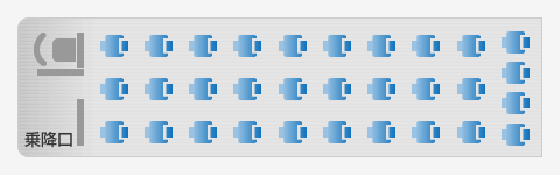
Single seats each separated by an aisle, laid out in a spacious 8–10 rows.
*1 The last row may have 4 seats.
*2 The recline angle may differ by vehicle.
*3 Pitch is measured from the feet to the seatback.
*These are general specifications for a 3-across independent seat. Actual figures vary by the vehicle in service.
Take a look inside a 3-across independent bus
- Independent seats, so your neighbour never bothers you

- Some buses even have footrests and legrests

- With a curtain, it feels like your own private room
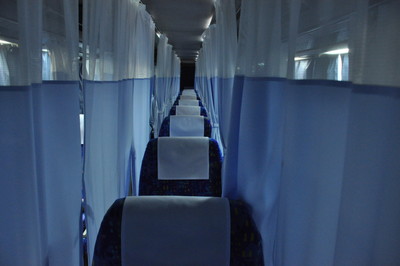
*Photos and seat maps are examples only and differ by vehicle. Always check the details page of each bus plan.
5 reasons to choose 3-across independent seats
3-across independent seats are recommended for
Frequently asked questions about 3-across independent seats
- What is the difference between 3-across independent seats and 3-across (2+1) seats?
- 3-across (2+1) seats place a pair of two seats and one single seat across an aisle, whereas 3-across independent seats have every single seat facing its own aisle, so all seats are fully independent. No one sits beside you, giving you a more private space.
- How do 3-across independent seats differ from 4-across seats?
- The main differences are seat width, privacy and comfort. 4-across seats are 42–45 cm wide, while 3-across independent seats are 50–55 cm — about 10 cm wider — and each is fully separated by an aisle. The recline is also deeper at about 140 degrees, which suits sleeping on an overnight bus.
- Are there curtains?
- Many 3-across independent buses have curtains that block the view from the aisle. However, not every vehicle has them, so please check the details page of each bus plan.
- Can I use power outlets or USB charging?
- More and more vehicles have power outlets and USB charging ports. Filter by "with power outlet" when you search to list only services that have charging facilities.
- Is it safe for solo travellers?
- Yes. Because every seat is independent, no stranger will sit next to you even when you travel alone. Many services also offer women-only seats or women-only vehicles, so they are reassuring for women travelling alone too.
- Where can I search?
- On Kosokubus.com, enter your departure point, destination and date and filter by "3-across independent" to view and book the matching services.
- Are they only on overnight buses, or are there daytime services too?
- On shorter routes such as Nagoya–Osaka there are daytime services too. On long routes such as Tokyo–Osaka the services are mainly overnight. You can filter by "3-across independent" to check daytime and overnight services.
- Which is better, 3-across independent or 3-across (2+1)?
- For complete privacy, 3-across independent is superior. That said, 3-across (2+1) is often cheaper, and if your neighbour is a travel companion, 2+1 is comfortable too. We strongly recommend 3-across independent for solo travellers, women, and anyone who wants to sleep soundly.
- Is it safe for a woman travelling alone?
- Yes. The private, curtained space makes 3-across independent seats popular with women travelling alone. For extra peace of mind, choose a service with women-only seats or a women-only vehicle so that both passengers and crew around you are women.
- On what routes do they run?
- They run on major long-distance routes nationwide such as Tokyo–Osaka, Tokyo–Nagoya, Tokyo–Fukuoka and Osaka–Fukuoka. On Kosokubus.com you can narrow your search to 3-across independent services from around 160 operators nationwide.
Seat type comparison chart
← Scroll sideways →
| 4-across standard | 4-across relaxed | 3-across (2+1) | 3-across independent | |
|---|---|---|---|---|
| Type | 4-across | 4-across | 3-across | 3-across |
| Total seats | 44–45 | 37–41 | 27–30 | 27–30 |
| Recline angle | 120° | 140° | 140° | 140° |
| Seat width | 42–45 cm | 42–45 cm | 50–55 cm | 50–55 cm |
| Seat pitch | 70–90 cm | 110–135 cm | 100–130 cm | 100–130 cm |
| Layout | 4 seats per row × 11 rows across a central aisle | 4 seats per row × 9–10 rows across a central aisle | 3 seats per row × 9–10 rows across an aisle | Each seat separated by an aisle; every seat fully independent |
| Last row | May be a 5-seat version | May be a 5-seat version | May be a 4-seat version | May be a 4-seat version |
| Features | The standard sightseeing-bus type; its biggest appeal is the affordable price. The latest vehicles even offer a "theatre" type with a personal TV screen like an international flight. | With fewer rows than the standard, the legroom pitch is wider and more comfortable. Some vehicles have footrests or legrests. | A 2-seat pair plus 1 independent seat, wider than the standard. Some vehicles offer an even wider "wide seat." | On some vehicles each seat is curtained off for a semi-private feel, and there are "business class" vehicles with 20 seats or fewer. At this class most buses have generous amenities and are very comfortable. |
| Notes | *General specs for the standard type. Actual figures vary by vehicle. | *General specs for the 4-across relaxed type. Actual figures vary by vehicle. | *General specs for the 3-across type. Actual figures vary by vehicle. | *General specs for the 3-across independent type. Actual figures vary by vehicle. |
*All seat pitch figures are measured from the feet to the seatback.